Contents (7)
A Promptfoo alternative is a tool that takes over one of Promptfoo's jobs: evals in CI, red teaming (adversarial testing), or gating a release. After OpenAI's acquisition you may not need one. The MIT license held, and the project shipped more commits after the deal than before it. The decision you do need to make is who grades your tests, because every default judge now sits inside the company that owns the tool.
Suppose a team ships a Claude-based support agent and runs a Promptfoo red-team suite in CI. The runner is a build box where a developer once signed into Codex and never signed out. Nothing in the suite names a grader. So Promptfoo picks up the ChatGPT login and uses openai:codex-sdk for default text generation and grading, because no higher-priority API credentials are configured (data-handling doc). The target model still runs locally. The judge is an OpenAI model. Every verdict on whether a competitor's model held up now comes from an OpenAI model, and the build stays green the whole time.
01 / What changed when OpenAI bought Promptfoo
Ownership moved to OpenAI. The license and the pace of work stayed where they were.
Promptfoo announced the agreement on 2026-03-09, and its post said closing was subject to customary closing conditions (Promptfoo blog). No primary source gives a closing date, and the price is not public. So this piece uses the README's own wording. "Promptfoo is now part of OpenAI. Promptfoo remains open source and MIT licensed." (README). The LICENSE file still carries the MIT text (LICENSE).
The announcement made two commitments. The open-source suite would remain "a best-in-class red teaming, static scanning, and evals tool for any AI model or application" (blog), and Promptfoo would "continue to support a diverse range of providers and models". Those are promises. License terms are the only part you can enforce.
The direction of travel is on the record too. The founders wrote that they would "improve and integrate Promptfoo's core tech within the model and infrastructure layers" (blog). TechCrunch reported the technology would land in OpenAI Frontier, its enterprise agent platform (TechCrunch). At announcement, more than 350k developers had used Promptfoo, 130k were active each month, and teams at more than 25% of the Fortune 500 relied on it, by the company's own count.
FAULTLINE also counted commits on each default branch through the GitHub API on 2026-11-20, across two 8-month windows either side of the announcement. Promptfoo went from 2,676 commits before to 2,961 after. That is up 10.7%, with 39 releases since 2026-03-09 and version 0.126.0 published on 2026-11-18. Commit counts measure activity and say little about quality, and merge habits differ between repos, so compare each repo only with itself.
02 / The judge is the neutrality problem
Every default grading path in Promptfoo ends at OpenAI-owned inference, and that is where the exposure sits.
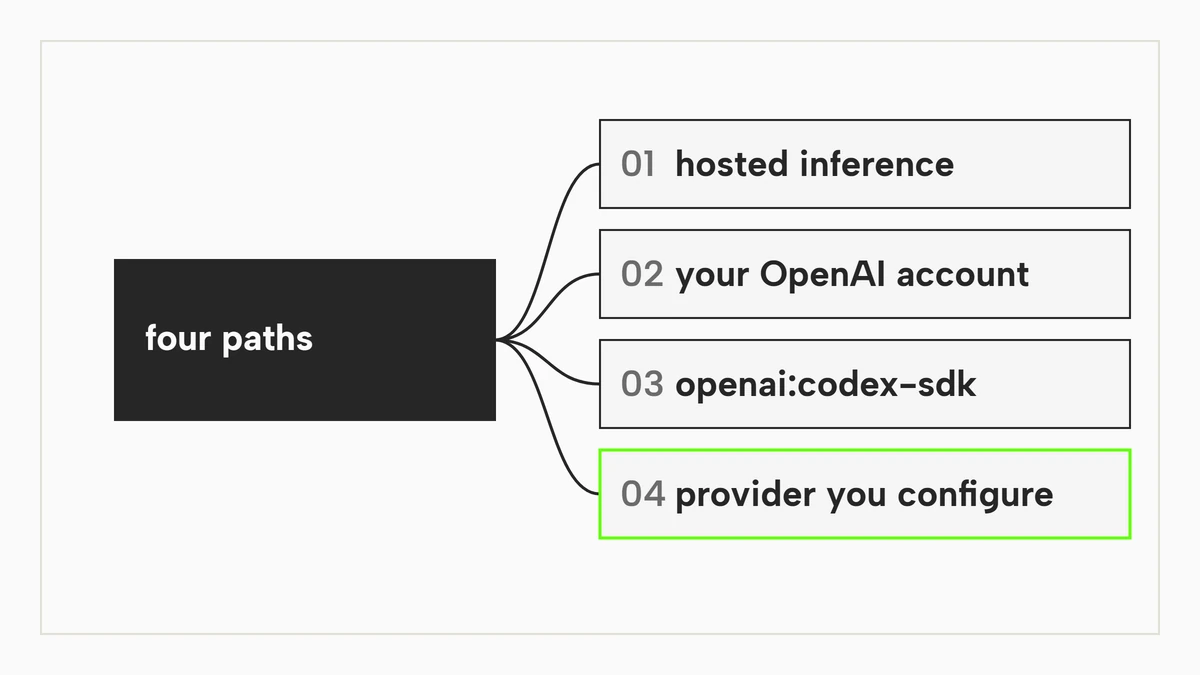
The data-handling page describes four paths (docs). With no key and no login, Promptfoo uses hosted inference at api.promptfoo.app for test generation and grading, and hosted grading receives the prompt sent to your target plus the target's response. With OPENAI_API_KEY set, both run through your OpenAI account. With Codex installed and signed in to ChatGPT, Promptfoo can use openai:codex-sdk locally for default text generation and grading when no higher-priority credentials exist. The fourth path is a grading provider you configure yourself.
The third path arrived after the deal. PR #8493, "feat(redteam): use Codex login for default text graders", merged on 2026-04-07 (PR). FAULTLINE read the data-handling page's commit history on 2026-11-20 and found no earlier change adding that default, which places it 29 days after the announcement. A convenience default for people with no API key proves nothing about intent. It does show the default judge moving closer to OpenAI after the deal.
Precedence decides which path you land on. An OPENAI_API_KEY outranks the ChatGPT login, and the login outranks hosted inference. The risky case is the quiet one, where nobody configured anything and a login left on a build box fills the gap.
Why should the judge's family matter? LLM judges (models that score another model's output) rate their own outputs higher than other models' outputs, while human annotators rate the same outputs as equal (arXiv 2404.13076). The same paper found that a model's ability to recognise its own text tracks the strength of that bias. The experiments used GPT-4 and Llama 2 in 2024, so the size of the effect on 2026 grader models is unknown. The direction alone is enough to justify one line of config.
This is a grading-integrity issue. Data exposure is a separate and smaller question. Promptfoo states that your target model is always evaluated locally, and that telemetry excludes prompt content, model responses, generated test cases, API keys and full config files (docs). The hard part to see is the verdict. It can come from a model whose owner competes with the system under test, and nothing in the MIT license governs that choice.
03 / Staying on Promptfoo: pin the grader
For evals, three settings remove most of the exposure. For red teaming, the same settings also remove coverage.
Start with the grader. The data-handling page shows this block for a grading provider other than the default:
Treat it as the shape and verify the result. Run one suite and check which model graded it. If the output names a model you never wrote down, the default won.
Then switch off the remote paths:
The first flag disables the supported remote-generation fallbacks. Promptfoo's docs are explicit that it "is not a network isolation guarantee and does not disable telemetry" (docs). The second flag stops usage telemetry, which already excludes content. Neither flag touches the judge. Only the provider setting does.
The price is coverage, because some plugins require Promptfoo's hosted inference and cannot run locally (docs). That list includes indirect prompt injection, SSRF, BOLA and several jailbreak strategies such as jailbreak:composite. Those are the harder attacks. If they sit in your threat model, disabling remote generation leaves a red-team gap. Read the remote-only list first, then write down which gaps you accept.
The CI gate survives all of this. Promptfoo can fail a build when quality thresholds are missed (CI docs), and the gate works the same with a grader you chose. FAULTLINE runs its own content pipeline on one rule that applies here. The checker always comes from a different model family than the drafter. That is a working practice, and FAULTLINE has no measured result for it yet.
04 / Open-source Promptfoo alternatives by job
No single tool replaces Promptfoo. Pick one tool per job, then check that its project is alive. For red teaming, start with PyRIT or garak. For evals, Inspect or DeepEval. For traces, Langfuse.
The commit counts below are FAULTLINE's measurement on 2026-11-20 through the GitHub API, over the same two 8-month windows. Read each row against itself.
| Job | Tool | License | What it does | Commits before -> after |
|---|---|---|---|---|
| Red teaming | garak | Apache-2.0 | Probes for hallucination, data leakage, prompt injection, jailbreaks and other weaknesses | 1,393 -> 911 (-34.6%) |
| Red teaming | PyRIT | MIT | Automated scans, adaptive multi-turn attacks and human-led testing, built by Microsoft's AI Red Team | 340 -> 1,761 (5.2x) |
| Red teaming | DeepTeam | Apache-2.0 | Red-team framework its authors call penetration testing for LLMs | 706 -> 234 (-66.9%), no release since 2025-11-12 |
| Evals (LLM evaluation) | Inspect | MIT | Framework from the UK AI Security Institute with over 200 pre-built evals | 1,703 -> 3,543 (2.1x) |
| Evals | DeepEval | Apache-2.0 | Pytest-style unit testing for LLM apps, with metrics run by an LLM you choose | 3,481 -> 1,632 (-53.1%) |
| Evals | Giskard v3 | Apache-2.0 | Rewrite for dynamic multi-turn agent testing, with v2 no longer maintained | 46 -> 362 (7.9x, v3 rewrite) |
| Traces and evals | Langfuse | MIT core, ee/ separate | Scores live traces, turns examples into datasets and compares experiments | 1,952 -> 4,390 (2.2x) |
| Release gate | faultgate | MIT | Reads recorded traces, checks structural failures and policy, compares a candidate against repeated baselines | FAULTLINE's own, excluded |
PyRIT went from 340 commits to 1,761 and shipped 9 releases, the latest v1.2.1 on 2026-11-18. Inspect doubled to 3,543. Langfuse went from 1,952 to 4,390. Giskard jumped from 46 to 362 on its v3 rewrite, and its README says v2 "remains available but is no longer actively maintained" (README). Pin the major version if you adopt it.
Three projects slowed. garak fell 34.6%, DeepEval fell 53.1%, and DeepTeam fell 66.9% with no release since 2025-11-12. A falling count is weak evidence on its own. A mature tool can simply need fewer commits. Read the release notes before you build a gate on any of them.
If you are weighing Promptfoo vs PyRIT or garak for red teaming, PyRIT is the stronger bet for multi-turn attacks, because adaptive multi-turn attacks are its stated purpose and it shipped 9 releases since the deal. For a broad probe sweep across injection, leakage and jailbreaks, garak covers that list, with a slowing commit count to weigh. Neither one authors evals the way Promptfoo does, so replacing Promptfoo fully means running at least two tools, one for attacks and one for evals.
Two disclosures. FAULTLINE makes faultgate, the release-gate row in that table. It is free and open source, its default checks run locally without a model, and it reads OTLP (the OpenTelemetry trace format) plus exports from Langfuse, LangSmith, Braintrust and Phoenix (faultgate). It does no red teaming and has no eval authoring. Langfuse has an owner too. ClickHouse acquired it (ClickHouse blog), and its MIT core sits beside separately licensed ee/ folders (LICENSE).
05 / Any tool can be acquired, so own your tests
The durable defence is portable tests, traces and gates. Every tool in that table can change owners.
Langfuse already did. It still ships an MIT core with separately licensed folders (LICENSE), and the same ownership question will return for every row above, including the projects growing fastest.
So keep the assets in formats another tool can read. Test cases live as plain YAML or JSON in your repo. Traces go out as OTLP, which faultgate accepts directly (faultgate). Gates read exports from more than one tool, so swapping the eval framework leaves the gate intact.
For a small team this costs almost nothing. A directory of YAML cases and a script that runs them survives any vendor change. The real failure is a single tool holding the only copy of the cases that define a release.
The strongest version is a gate with no judge at all. A gate whose default checks need no model has no judge to capture and no inference bill (faultgate). A code check sees less than a model judge. It also returns the same verdict on the same trace every time, which is what a release gate needs.
Two earlier FAULTLINE pieces cover why one run proves little: why a single successful run tells you almost nothing and how to test AI agents. The statistics of a gate that compares repeated runs are in regression or noise. For agents that call tools, the local firewall for MCP tool calls covers the runtime side.
06 / What to change on Monday
Name the grader model for every eval and red-team suite, and pick it from a different model family than the product under test.
The engineer who owns the CI eval job makes the change. The CTO signs off, because a grader change can move benchmark results and someone will ask why.
Track two numbers. The first is the share of CI verdicts graded by an explicitly configured model, with a target of 100%. The second is the count of suites still using remote-only plugins, reviewed each quarter. Both come straight from config files, so nobody has to trust a dashboard.
Start with the suites that test anything competing with OpenAI, since those carry the conflict of interest, and move the rest in the following sprint.
Questions#
Is Promptfoo still open source after the OpenAI acquisition?
Yes. The README says Promptfoo is now part of OpenAI and remains open source under the MIT license, and the LICENSE file is still the MIT text. FAULTLINE counted 2,961 commits in the 8 months after the 2026-03-09 announcement against 2,676 before, with 39 releases since.
Does Promptfoo send my prompts to OpenAI?
It depends on configuration. Your target model is evaluated locally, and telemetry excludes prompts and responses. Hosted grading receives the target's responses. If you set an OpenAI key, generation and grading run through your OpenAI account. If a Codex or ChatGPT login is present and no API key is set, that login can become the default grader.
Can I use Promptfoo without an OpenAI API key?
Yes. You can configure another provider for grading, and the docs show an Anthropic model as the example. Without an API key and without a configured provider, a signed-in Codex or ChatGPT login can become the default grader. If neither exists, generation and grading fall back to hosted inference.
What is the best open-source alternative to Promptfoo for red teaming?
PyRIT and garak cover the job. PyRIT is built by Microsoft's AI Red Team for automated scans, adaptive multi-turn attacks and human-led testing, and it grew from 340 to 1,761 commits in the 8 months after the deal. garak probes for injection, leakage, jailbreaks and more, and its commit count fell from 1,393 to 911. Read the release notes for both before adopting.
Is Promptfoo still maintained?
Yes. FAULTLINE measured 39 releases since 2026-03-09, the latest 0.126.0 on 2026-11-18, and commits rose 10.7% against the previous 8 months. Commit counts measure activity, not quality, so read the changelog for the areas you depend on.