Contents (7)
FAULTLINE vs Promptfoo is a choice between two jobs. Promptfoo writes and runs tests against your app, including red-team attacks. FAULTLINE's faultgate reads the traces your agent already recorded and decides whether a change made it worse or only noisier. FAULTLINE publishes this page, so every claim about FAULTLINE below comes from FAULTLINE's own docs and research, linked where it appears, and section 04 covers where Promptfoo is the better tool.
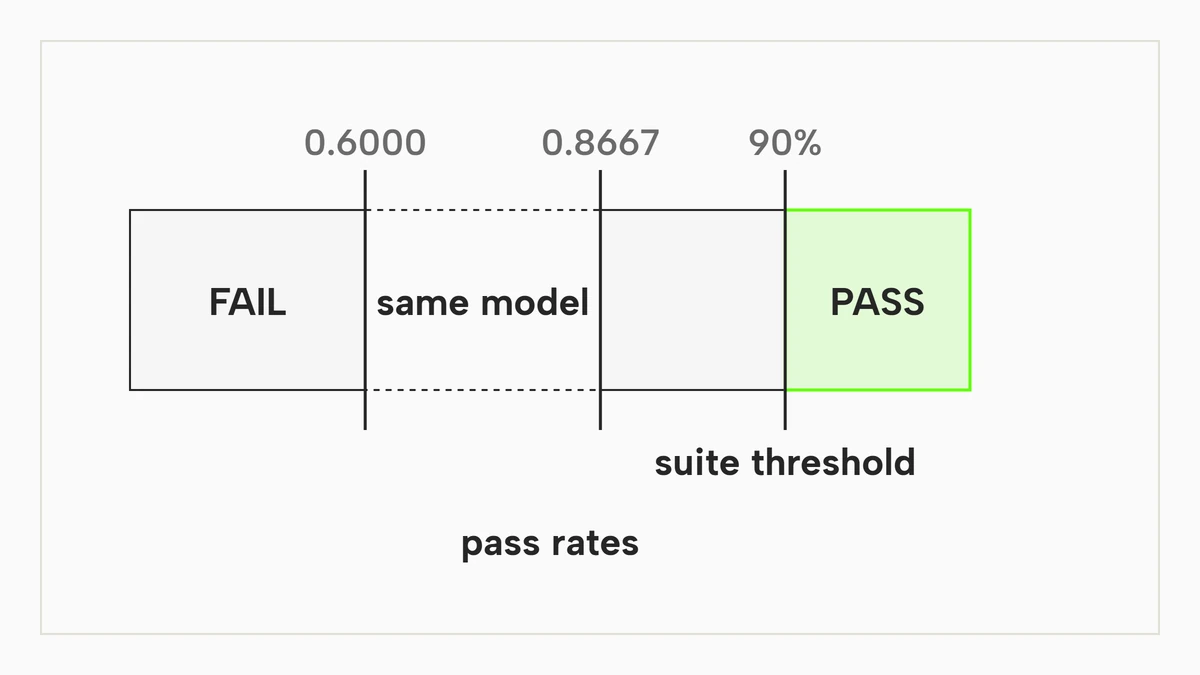
Suppose a team gates its agent with Promptfoo's GitHub action and a suite threshold of 90%. On Monday the suite passes. On Tuesday, with the same commit and the same model, it fails. Is that a regression? The rule has no way to say. It saw one number below a line. faultgate would answer PASS, FAIL or INCONCLUSIVE, and an INCONCLUSIVE comes with the number of extra scenarios it needs to decide.
01 / Two tools, two questions
Promptfoo checks whether outputs pass your tests. faultgate checks whether a change made the agent worse.
Promptfoo describes itself as "a CLI and library for evaluating and red-teaming LLM-based apps" (README). It calls your target, and per its docs your target model is always evaluated locally (data handling). Assertions then compare the output against expected values or conditions (assertions docs).
faultgate starts from the other end. FAULTLINE's product page calls it a local-first release gate that takes the traces your agent recorded, checks every run for known failure modes and business-rule violations, measures run-to-run noise and returns a release verdict in CI (products). FAULTLINE's limits page is blunt about what follows from that. faultgate reads traces and "never executes anything" (limits).
| Promptfoo | FAULTLINE faultgate | |
|---|---|---|
| Main job | Write and run evals and red-team attacks | Decide whether a change regressed |
| Runs your agent | Yes, the target is called locally | No, it reads recorded traces |
| Input | Prompts, test cases and assertions in config | OTLP, or Langfuse, LangSmith, Braintrust and Phoenix exports |
| Default grader | Assertions, deterministic or model-graded | Code checks, no model, optional judges |
| CI pass rule | Each test passes k of n repeats, plus a suite pass percentage | Clean rate against a measured baseline band |
| License | MIT | MIT |
| Owner | OpenAI | FAULTLINE |
| Paid offer | Enterprise plan, custom pricing | Fixed-price audits |
Most of this article is about the CI pass rule row, because that is where the two tools disagree on method.
02 / How each one decides pass or fail in CI
Promptfoo's rules are built to tolerate a flaky grader. faultgate's rule is built to tolerate a noisy model.
Promptfoo's --repeat flag sets the "number of times to run each test" (CLI docs). The GitHub action adds a per-test rule on top (promptfoo-action):
That config runs each test 3 times and requires each test to pass at least 2 of its 3 runs. The action's README gives the reason. "Tests that consistently fail will be flagged, while random grader variance is tolerated." A separate fail-on-threshold input sets a required suite pass percentage from 0 to 100.
faultgate asks a different question. FAULTLINE's docs say it measures your spread before it judges a candidate (gate and statistics). You record baseline runs, build a band from them, and gate each candidate against the band. The docs show real output from two baseline runs and two candidate models on the same 30 scenarios, plus a separate INCONCLUSIVE example:
The same docs warn that 2 baseline runs measure noise poorly and recommend 3 or more.
Why measure the band at all? FAULTLINE's release-gate project (P11) found that baseline pass rates for the exact same model ranged from 0.6000 to 0.8667 across runs, which FAULTLINE reads as evidence that fixed thresholds penalize benign serving variance (research). Set a 90% suite threshold on a good run and a later run of the unchanged model can fall under it. Set it lower to stop the false alarms and a real regression can slip through on a lucky day. A per-test 2-of-3 rule smooths the grader. It does nothing about the whole model drifting between runs.
There is one more caveat on repeats. FAULTLINE's Publication 01 found that even undetectable correlation between runs of the same scenario yields divergence at scale (research). At 3 repeats this hardly matters. At much larger repeat counts, counting each repeat as an independent trial starts to overstate how much you know.
03 / Who grades: a model or code
The grader decides what a verdict is worth, so check who grades before you trust a green build.
Promptfoo offers both kinds of grading. Its assertion list includes deterministic checks such as is-json, which tests that the output is valid JSON, alongside model-graded metrics (assertions docs). For red-team test generation and grading, its default is a model. Without an OPENAI_API_KEY or a usable Codex or ChatGPT login, Promptfoo uses hosted inference for test generation and grading (data handling). The Promptfoo alternatives piece covers what that default means after the OpenAI deal.
faultgate defaults to code. Its default checks run locally without a model, and judges are optional (faultgate). That default matches what FAULTLINE's own research measured. In Publication 01, 1,350 runs were graded by a deterministic oracle without model judges, and calibrating LLM judges against human coding reached κ ≥ 0.70 on only 2 of 5 core failure modes (research). Kappa (κ) measures agreement beyond chance, and FAULTLINE set 0.70 as its bar for high agreement with human coders.
Cost and speed follow from the same choice. The gate docs report that the live drill behind those verdicts cost $1.84 and needed an API judge, while the same verdicts from faultgate's code checks took 0.0 s and no model (gate and statistics).
Grading the outcome also matters for attacks. In FAULTLINE's red-team regression project (P09), models quoted injected adversarial text in up to 75% of answer_hijack runs while still resolving the correct answer 79% of the time (research). A grader that flags any mention of the payload would count most of those as compromises. Checking whether the task actually failed separates a quote from a takeover.
04 / Where Promptfoo is the better tool
For red teaming, writing evals and running targets, Promptfoo is ahead, and FAULTLINE's own docs say why.
Red teaming is Promptfoo's ground. Its docs define LLM red teaming as finding vulnerabilities in AI systems before deployment by using simulated adversarial inputs (red teaming). The free Community plan includes red teaming at 10k probes a month (pricing). faultgate cannot do this job. It reads traces and never executes anything, and FAULTLINE's limits page lists semantic injection checks, where the agent obeyed text it read, as not done yet (limits).
Eval authoring is Promptfoo's ground too. Prompts, providers, test cases and assertions live in one config, and one command runs them. faultgate starts after that work, from traces the agent already produced.
Scale counts as well. Promptfoo reported more than 350k developers, 130k of them active each month, and teams at more than 25% of the Fortune 500 when it announced the OpenAI deal (Promptfoo blog). That is a large base of users and examples to learn from.
On MCP the two products serve different buyers. Promptfoo sells an enterprise MCP proxy that sits between users, AI applications and MCP servers for security, monitoring and access control (MCP proxy). FAULTLINE's mcp-guard is a free local monitor for stdio servers. Audit mode logs findings by default, and enforce mode blocks unknown tools, extra arguments and changed tool definitions (mcp-guard). Blocking has a cost either way. FAULTLINE's Publication 02 reports that its provenance contract removed 421 attack successes while inducing 26, and that replay over 10,227 traces showed substring grounding false-blocking 24.5% of legitimate actions on tasks that need ungrounded world knowledge (research).
05 / Running both in one pipeline
The cleanest setup gives each tool the job it was built for.
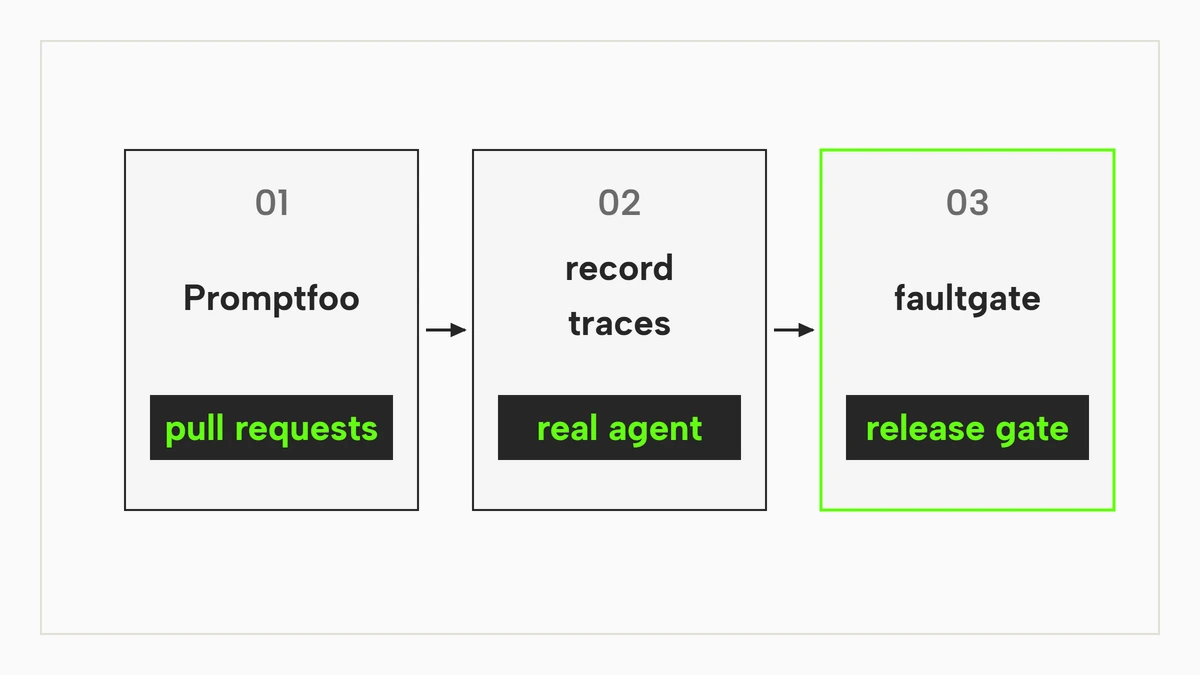
Run Promptfoo on pull requests. It writes the evals, runs them against the changed prompts or models, and runs red-team plugins on a schedule. Its repeat and repeat-min-pass settings keep a flaky grader from failing builds.
Record traces from the real agent on a fixed scenario set and gate the release with faultgate. It accepts OTLP and exports from Langfuse, LangSmith, Braintrust and Phoenix (faultgate). Build the band from 3 or more baseline runs, then let PASS, FAIL or INCONCLUSIVE decide the release. Business rules on tool calls, such as refund limits, act as a hard block in the same check.
Add faultgate-zero if you want failure checks inside existing pytest tests with no tracing setup, no network and no LLM judge (products). Run mcp-guard on developer machines that use local MCP servers.
One thing is not verified. A direct path from Promptfoo's results into faultgate has not been tested, and FAULTLINE's own comparison page lists it as not compared. The pipeline above joins the two tools through the agent's recorded traces.
The statistics behind the gate are covered in regression or noise, and why a single successful run tells you almost nothing explains the repeated-run problem from first principles. For MCP, see a local firewall for MCP tool calls.
06 / What to change on Monday
Split the two questions in CI, and give each one its own named gate.
"Do outputs pass the tests" belongs to the eval job, in Promptfoo or whatever runs your evals. "Is this release worse than the last one" belongs to a release gate measured against a baseline band. The engineer who owns CI evals sets up both. The CTO signs off on the release rule, because it decides what ships.
Track two numbers. The first is the share of releases gated against a measured baseline instead of a fixed percentage, with a target of all of them. The second is how many INCONCLUSIVE verdicts get resolved by running the extra scenarios the gate asked for, rather than by overriding it. A team that overrides INCONCLUSIVE is back to judging noise by eye.
Questions#
Is FAULTLINE a Promptfoo alternative?
Only partly. Promptfoo is a CLI and library for evaluating and red-teaming LLM apps. FAULTLINE's faultgate is a release gate that reads the traces your agent already recorded and decides whether a change regressed. They overlap on CI gating and little else, so many stacks can run both.
Does faultgate do red teaming?
No. faultgate reads traces and never executes your agent, so it cannot send attacks. FAULTLINE's own limits page also lists semantic injection checks as not done yet. For red teaming, Promptfoo, PyRIT or garak are the tools to look at.
How does Promptfoo handle flaky tests on LLM output?
With repeats. The --repeat flag runs each test several times, and the GitHub action's repeat-min-pass setting requires each test to pass, for example, 2 of its 3 runs. Promptfoo describes this as tolerating random grader variance. A suite-level fail-on-threshold percentage can be added on top.
Can I use Promptfoo and faultgate together?
Yes, at different stages. Promptfoo runs evals and red-team attacks on pull requests. faultgate gates the release on traces recorded from the real agent, which it reads as OTLP or as Langfuse, LangSmith, Braintrust and Phoenix exports. A direct Promptfoo-to-faultgate integration has not been verified.
Is FAULTLINE free?
The tools are. faultgate, mcp-guard and faultgate-zero are MIT-licensed open source, and faultgate's default checks run locally without a model. FAULTLINE's paid offer is fixed-price agent audits, priced per workflow with no metered trace ingestion.