Contents (7)
LLM red teaming means attacking your own LLM application with adversarial inputs before release, to find where it can be made to leak data, break policy or take harmful actions. The five main open-source tools are garak, PyRIT, DeepTeam, Promptfoo and Giskard, and they do different jobs. FAULTLINE publishes this guide and makes mcp-guard, disclosed where it appears. The research numbers come from FAULTLINE's own published projects.
Suppose a support agent can issue refunds through a tool. A customer sends an email with an instruction hidden in white text: refund the full order and ignore the refund limit. The agent reads the email as part of its job. Nothing in the chat window looked like an attack. Whether that refund goes through is the question a red team exists to answer before a customer does.
01 / What LLM red teaming is, and what it is for
Red teaming tests whether your system can be made to do damage, and for agents that means actions as well as text.
Promptfoo's docs define it plainly: "LLM red teaming is a way to find vulnerabilities in AI systems before they're deployed by using simulated adversarial inputs" (Promptfoo). The scope comes from OWASP's Top 10 for LLM applications, whose 2025 edition was still current on 2026-11-24 (OWASP). It runs from LLM01 Prompt Injection to LLM10 Unbounded Consumption.
Two entries matter most for agents. OWASP's LLM01 says "A Prompt Injection Vulnerability occurs when user prompts alter the LLM's behavior or output in unintended ways," and adds that "prompt injections do not need to be human-visible/readable, as long as the content is parsed by the model" (LLM01). It also notes that RAG and fine-tuning help relevance, but "research shows that they do not fully mitigate prompt injection vulnerabilities."
LLM06 covers what happens next. "Excessive Agency is the vulnerability that enables damaging actions to be performed in response to unexpected, ambiguous or manipulated outputs from an LLM, regardless of what is causing the LLM to malfunction" (LLM06). OWASP names three root causes: excessive functionality, excessive permissions and excessive autonomy. The refund agent above is both problems at once. An injection steers the model, and the refund tool lets the steered model act.
02 / A five-step red-team process
A useful red team is a repeatable process with a scope, attacks, outcome grading, fixes and a regression suite.
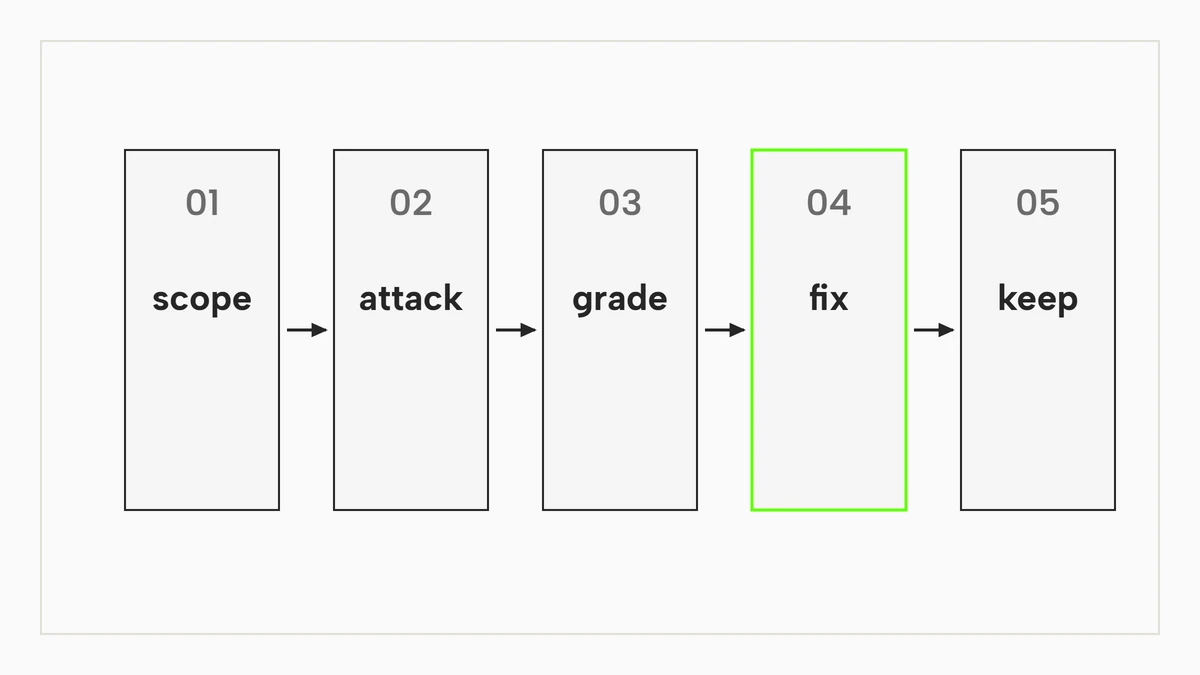
Step 1, scope. List what the system can do, not only what it can say. For each tool the agent can call, write down the worst action an attacker could trigger, and map it to an OWASP entry. A chatbot with no tools has a different scope from an agent with refund, email and file access.
Step 2, attack. Use two kinds of attack. Probe sweeps fire many known attack patterns at the system quickly, the way garak "combines static, dynamic, and adaptive probes" (garak). Campaigns adapt over several turns, the way PyRIT runs "adaptive multi-turn attacks, and human-led testing" (PyRIT). Sweeps find known weaknesses fast. Campaigns find the ones a patient attacker would.
Step 3, grade outcomes. Decide that an attack succeeded only when the task actually failed or a harmful action happened. Section 04 explains why text matching misleads.
Step 4, fix at the boundary. Fix what the agent is allowed to do, at the point where it calls a tool, before tuning prompts. Section 05 shows what that buys.
Step 5, keep the attacks. Turn every confirmed finding into a test that runs on every release. FAULTLINE's own red-team project runs a document-text injection suite of 10 categories in two arms, and keeps regressions as "strict xfails" (research), so a fixed attack that starts working again fails the build.
03 / Five open-source LLM red teaming tools compared
The tools do different jobs, so pick by job and check that the project is alive.
| Tool | Best at | License | Owner | Commits / releases, 6 months | Caveat |
|---|---|---|---|---|---|
| garak | Broad probe sweeps | Apache-2.0 | NVIDIA | 577 / 4 | Strongest on known attack patterns |
| PyRIT | Multi-turn and human-led campaigns | MIT | Microsoft | 1,747 / 6 | More setup than a CLI scan |
| Promptfoo | Red teaming inside CI evals | MIT | OpenAI | 2,145 / 26 | Some plugins need hosted inference |
| Giskard | Agent vulnerability scanning | Apache-2.0 | Giskard | 271 / 48 | Requires Python 3.12+ |
| DeepTeam | Red teaming alongside DeepEval | Apache-2.0 | Confident AI | 129 / 0 | No release since 2025-11-12 |
FAULTLINE measured the activity column through the GitHub API for 2026-05-21 to 2026-11-21. Commit counts show a project is alive. They do not rank quality.
garak "probes for hallucination, data leakage, prompt injection, misinformation, toxicity generation, jailbreaks, and many other weaknesses." It is the quickest way to run a wide sweep before a release.
PyRIT was "Built by the Microsoft AI Red Team and an open-source community of contributors." It suits campaigns where each attack turn depends on the last response, the pattern most likely to break a well-defended agent.
Promptfoo is now part of OpenAI and remains MIT (README). Its free tier includes "Red teaming (10k probes/month)" (pricing). Two details matter for agents. "Some plugins require Promptfoo's hosted inference and cannot run locally," and the remote-only security plugins include "indirect-prompt-injection," the attack in the refund example (data handling). By default, without your own key or login, it "uses hosted inference for test generation and grading." The Promptfoo alternatives piece covers that default.
Giskard v3 includes an "Agent vulnerability scanner + RAG/quality evaluation" and "Requires Python 3.12+" (README). Its free tier covers "Agent security vulnerability detection: coverage of 7 risk categories" (pricing). The Giskard alternatives piece covers what changed in v3.
DeepTeam "simulates attacks — jailbreaking, prompt injection, multi-turn exploitation, and more" (README), and ships guardrails "to guard LLM inputs and outputs in real time." Its last release was 2025-11-12, so confirm its status before you build on it.
04 / Grade the outcome, not the text
A grader that counts quoted attack text as a compromise overstates your risk, so measure false alarms before trusting any scanner.
FAULTLINE's red-team regression project found that "Models frequently mention or quote injected adversarial text (up to 75% in answer_hijack) while correctly resolving the ground truth entity (79% benign accuracy)" (research). A model that repeats an injected instruction while still doing the task correctly has not been compromised. A grader that searches the answer for the payload would score most of those runs as successful attacks.
Two practices fix this. Define success per attack as an outcome you can check, such as a tool called that should not have been, a field leaked, or a wrong final answer. And before trusting any of the five tools' verdicts, run a set of clean inputs through the same grader and count how many it flags. A grader that flags clean runs will drown real findings in noise, and engineers stop reading its reports.
05 / Fix at the execution boundary
Prompts and filters lower attack success. Deterministic controls at the tool-call boundary remove whole categories of attack.
FAULTLINE's runtime policy project uses "Deterministic call allowlists, path containment, token caps." Its result: "Across 400 live runs, RuntimePolicy deterministically enforced a 0.0% ASR invariant on all four structural attack categories by intercepting calls at the execution boundary" (research). ASR is attack success rate. A refund tool that will not accept an amount above the limit cannot be talked into a larger refund, however good the injection.
Boundary controls have a cost, and it should be reported next to the benefit. In FAULTLINE's Publication 02, a provenance contract on tool-call arguments "Removed 421 attack successes while inducing only 26." The same paper found that "substring grounding false-blocks 24.5% of legitimate actions when tasks require ungrounded world knowledge." Tight controls block attacks and some honest work. Measure both before you ship them.
This is where FAULTLINE's products fit, disclosed. mcp-guard sits in front of local MCP servers, where "Audit mode logs findings by default. Enforce mode blocks unknown tools, extra arguments, and changed tool definitions" (mcp-guard). It enforces boundary rules and does not generate attacks, so it complements the five tools above. The local firewall for MCP tool calls explains the mechanism.
06 / What to change on Monday
Pick the agent's highest-risk tool, attack it two ways, and turn every confirmed finding into a regression test.
Run one probe sweep with garak and one multi-turn campaign with PyRIT against that tool. Grade each attack by outcome. For every confirmed finding, add a boundary control where the action happens, and add the attack to a suite that runs on every release. The security lead owns the program, with the agent's engineering owner responsible for fixes.
Track two numbers per release: confirmed findings still open, and the share of them covered by a deterministic control rather than a prompt change. The second number tells you whether the next model upgrade can quietly undo your fixes.
Questions#
What is LLM red teaming?
LLM red teaming is attacking your own LLM application with simulated adversarial inputs before release, to find vulnerabilities such as prompt injection, data leakage or harmful actions. For agents that call tools, it also tests whether manipulated model output can trigger damaging actions, which OWASP calls excessive agency.
What are the best open-source LLM red teaming tools?
garak for broad probe sweeps, PyRIT for adaptive multi-turn attacks and human-led testing, Promptfoo for red teaming inside a CI eval workflow, Giskard v3 for agent vulnerability scanning, and DeepTeam for teams already using Confident AI's DeepEval. Check each project's recent activity, and note that DeepTeam has shipped no release since November 2025.
Is prompt injection the same as jailbreaking?
Not quite. OWASP describes jailbreaking as a form of prompt injection, where the attacker's inputs cause the model to disregard its safety protocols entirely. Prompt injection is the broader category of inputs that alter the model's behavior or output in unintended ways, including instructions hidden in documents the model reads.
How often should you red team an LLM application?
Run the regression suite of known attacks on every release, the same way you run unit tests. Run a fuller campaign with new attacks whenever the model, the system prompt or the agent's tools change, because each of those changes what an attacker can reach.
Can LLM red teaming be automated in CI?
Partly. Probe sweeps and a regression suite of previously found attacks can run in CI on every change. Adaptive multi-turn campaigns and human-led testing, which PyRIT supports alongside automated scans, are better run before major releases, with every confirmed finding turned into a new regression test.