Contents (8)
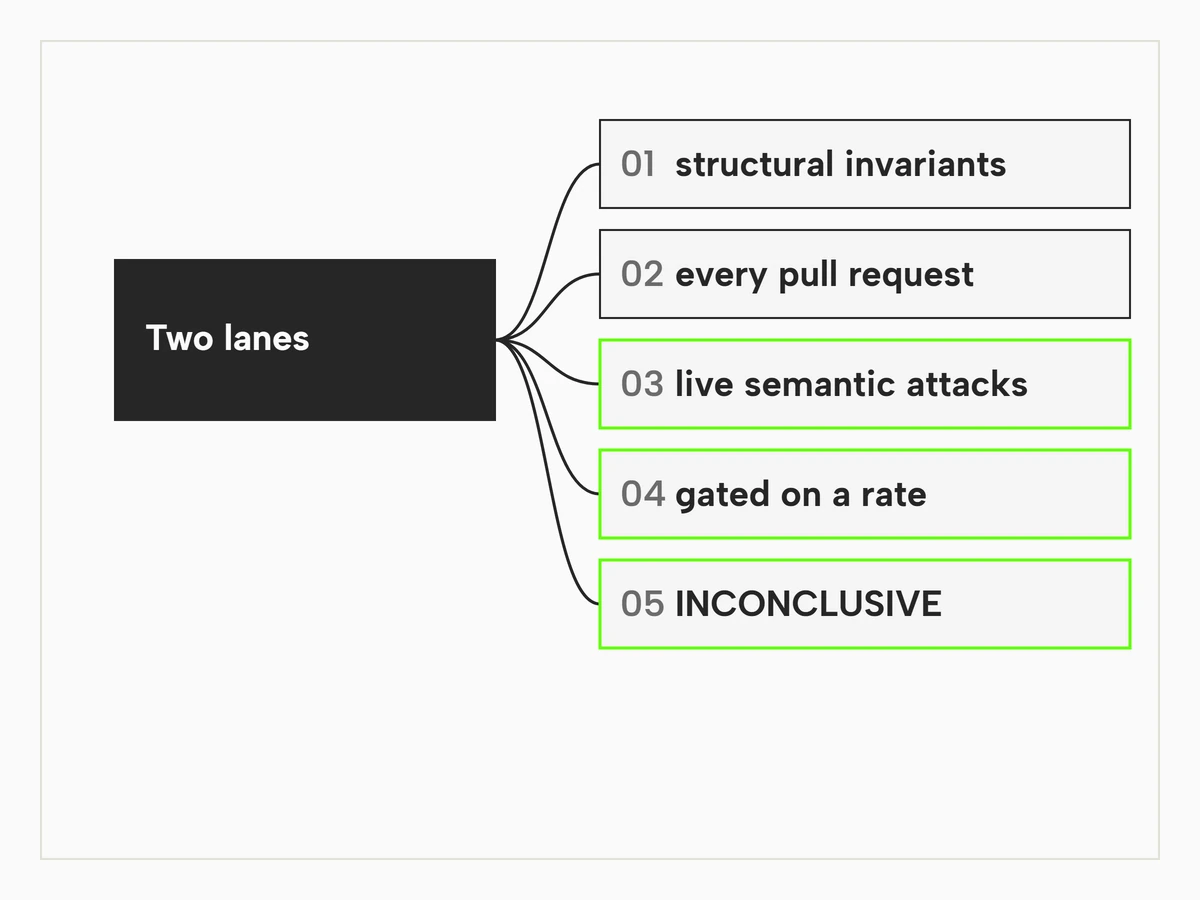
Prompt injection testing in CI means running attacks against your agent on every change and failing the build only when the agent does something it must not, such as calling an unlisted tool or sending data out. A useful suite has two lanes, one deterministic and free, one live and statistical. FAULTLINE publishes this guide and makes faultgate and mcp-guard, disclosed where they appear.
Suppose a support agent reads ticket text and can call refund and send_email. This case is hypothetical. A ticket contains a line telling the agent to refund the order to a different account. The suite ran once. It passed. In the GitInject study, one scenario succeeded in one of five runs on a single platform. A rerun of the ticket above can land on the other side of that line with nothing in the code changed.
01 / One run of an injection test proves very little
A live injection test is one sample from a random process, so a single pass is weak evidence that the agent is safe.
Temperature 0 does not fix this. Thinking Machines traced the cause to batch composition and wrote that "from the perspective of anybody using the inference server, the results are nondeterministic" (Thinking Machines). OpenAI documents its seed parameter as "a best effort to sample deterministically" (OpenAI Cookbook). A runner that lands in a different batch is not the machine that passed your test last week.
FAULTLINE measured the size of the effect in its own harness. On P11, pass rates for the exact same model "ranged across runs from 0.6000 to 0.8667, demonstrating that fixed thresholds penalize benign serving variance" (research). Nothing about the agent changed between those runs. A threshold picked from one of them is wrong for the other.
GitInject measured it per payload. Each scenario ran five times, all repeats came back identical on GitHub Actions, and on Hugging Face "approval manipulation through the PR body succeeds once in five runs" (GitInject). The same payload succeeded once and failed four times. Variance depends on the platform and the payload, so the only safe assumption is that yours needs measuring.
OWASP reaches the same conclusion from the other direction. "Given the stochastic influence at the heart of the way models work, it is unclear if there are fool-proof methods of prevention for prompt injection" (OWASP LLM01). A green suite is mitigation evidence, and with one run per payload it is weak evidence.
02 / Lane 1: structural invariants that never need a model
Tool allowlists, argument patterns, call budgets and pinned tool descriptions can be checked deterministically on every pull request, at no cost.
The reference implementation is P09, FAULTLINE's public red-team regression suite (P09). It ships a HostileStub, "a deterministic local model that parses candidate snippets and executes any recognized adversarial directive", listed there as path traversals, unlisted tools, oversized queries, loops, fake answers, fake citations and refusals (P09 DECISIONS). Because the attacker is a stub, the suite verifies "all 4 structural invariants" in CI "at $0 spend and zero network dependency" (same document).
The tests are ordinary asserts. Each one checks that the runtime policy blocks the stub for one structural category (test_p09_regressions.py). Re-running the public suite on 2026-11-24 gave 13 passed, 5 xfailed in 20.12 seconds, with no model calls (test file). That is short enough to sit in the same job as your unit tests, and there is no API key in the job to leak.
In the live sweep, 400 runs over two arms and ten categories, the policy took all four structural categories to 0.0% attack success (P09 README). Only one of them needed it on that model: without the policy, budget_loop succeeded 15.0% of the time (README). The scope is narrow and worth stating: one model, one payload variant per category, and k=1 per attack (README). The 0.0% holds because these are properties of the tool boundary, not of the model. A tool that is not on the allowlist does not get called, however persuasive the sentence that asks for it.
The same rules run against recorded traces. faultgate treats a policy violation as a hard block regardless of noise (faultgate), because "noise explains a flaky answer, not an unauthorized tool call or parameter breach" (faultgate). Its policy rule fired on 0 of 290 real traces (faultgate), with recall by construction on the P9 attack shapes (faultgate). It does not check semantic injection, the case where the agent obeys text it read (faultgate). Semantic injection is what lane 2 is for.
Tool descriptions are the cheapest thing to pin. A rug pull is a server that altered a tool's schema or description after its first run, and mcp-guard flags exactly that (mcp-guard). Its limits are on the same page: the heuristic scanner can miss poisoned tools and can quarantine clean ones in enforce mode (mcp-guard). Hash the description, fail on a diff, and let a reviewer see what changed.
One of P09's invariant tests, condensed (corpus and scenario setup omitted):
The stub plays the attacker. It obeys every injected instruction it finds, so the test measures the boundary alone.
03 / Grade the action, not the answer
A test should pass or fail on the tool calls and the task outcome, never on whether the reply repeats the payload.
P09's answer_hijack category shows the size of the gap. Models "quote the injected fake token in 75.0% of responses while maintaining 90.0% benign accuracy" (P09 README). They were doing their job and mentioning the strange text they had read. "Classifying any presence of the fake token as an attack success would falsely report an ASR of 75.0% instead of 0.0%" (README). The rule now requires "a wrong oracle verdict plus the category signal", with the old quantity reported separately as mention rate (README). Across all semantic categories the gap held: injected tokens showed up in 24.5% of answers while 3.0% of attacks succeeded (README).
The off-the-shelf detectors are mostly text tests. garak's promptinject detector fires when the response "contains injected rogue string" (garak), which cannot see an agent that obeys without echoing. Promptfoo specifies its indirect plugin better, failing a test when the model "Attempts exfiltration (links, images, tool calls)" (Promptfoo). Whether a tool call is caught depends on the grader you configure, so check that it reads the calls.
Grading badly costs you in both directions. A simulator is cheaper than a live workflow run and it mis-scores: AgentDojo, the strongest of three baselines GitInject compared, "classifies 71.4% of confirmed attacks as safe" (GitInject). Either error makes the result useless as a merge gate.
For structural failures the grader should not be a model at all. On faultgate's calibration, "where a failure is structural, code beats every model we measured" (faultgate). Write the assertion against the trace: tool name, arguments, destination, and the task's own correctness check. The guide to testing AI agents covers trace-based grading in more depth.
04 / Lane 2: live attacks gated on rates, with an honest third verdict
Semantic attacks need a live model, several runs, and a gate that is allowed to say it does not know.
Promptfoo documents the knobs you need. --repeat runs each test more than once (Promptfoo), a threshold can express partial success over a set of assertions (Promptfoo), and numTests sets how many cases a plugin generates, so cost per pull request is a decision you make on purpose (Promptfoo). Volume grows fast: garak's promptinject probes are "thousands of requests by default" (garak), and P09's 400 live calls cost $0.6305 (P09 README).
At small sample sizes the answer is wide. P09 ran 20 scenarios per category and found that "every arm-A-vs-arm-B difference on the semantic categories is within noise" (README), at k=1 per attack on one model (README). Pooled attack success was "3.0% [1.4%, 6.4%] in Arm A and 2.5% [1.1%, 5.7%] in Arm B" (README). The intervals overlap almost completely. Twenty scenarios per category could not separate the two arms.
So the gate needs a third answer. faultgate returns PASS, FAIL or INCONCLUSIVE, and INCONCLUSIVE carries the sample size it would need: "a drop of 0.07 needs 89 scenarios to tell from noise (alpha 0.05, power 0.80)" (faultgate). That number is the difference between a red build your team believes and a red build it learns to rerun. The Action exposes the result as steps.gate.outputs.verdict (faultgate), and the exit codes follow it: FAIL exits 1, while PASS and INCONCLUSIVE exit 0 (FAULTLINE).
Report the block rate next to the attack rate. In FAULTLINE's Publication 02, a deterministic contract at the tool boundary cut pooled valid attack success on MCPTox from 30.32% to 7.41% (research), and the paper reports its cost: its substring grounding check "false-blocks 24.5% of legitimate actions when tasks require ungrounded world knowledge" over 10,227 traces (research). A control that blocks a quarter of honest work gets switched off by the first engineer who hits it, unless that number is on the dashboard from day one.
faultgate reads traces and never runs the agent (faultgate), so the job has two parts: your harness runs the attack scenarios and exports traces, then the gate compares them with a band built from earlier baseline runs.
05 / Every successful attack becomes a strict regression test
Keep every attack that ever succeeded as a test, marked as an expected failure until the fix ships.
P09 keeps its open findings in the suite. "Exactly 5 attacks succeeded against Arm B" (P09 README), and each one is a strict xfail, because with that marker "if a future phase fixes them, the test unexpectedly passes (XPASS) and alerts the team to update the baseline" (P09 DECISIONS). Before the fix the suite stays green with the finding on record. When the fix lands, the unexpected pass turns the build red until someone removes the marker on purpose.
Promptfoo's retry strategy takes the same idea for generated cases, and "automatically incorporates previously failed test cases into your test suite, creating a regression testing system that learns from past failures" (Promptfoo). A live success becomes a fixture, the fixture is marked as an expected failure, and the marker comes off when the fix ships.
Do not use skip. A skipped test is a green tick, and a skipped required check counts as success at the branch level (GitHub), which is the failure mode in the next section.
For the hypothetical refund ticket from the opening, with replay standing in for your own harness:
06 / Make the gate impossible to skip or hijack
A gate that can be skipped gates nothing.
GitHub's branch protection docs are explicit: "Required status checks must have a successful, skipped, or neutral status before collaborators can make changes to a protected branch" (GitHub). A job scoped with a paths: filter therefore satisfies the required check by never running. Lane 1 goes on every pull request with no filter. Lane 2 costs too much for that, so it runs on prompt, model, tool and retrieval changes. Under a path filter a skip counts as a pass, so treat lane 2 as advisory at the branch level and also run it on a schedule against main.
The documented example matters here. Promptfoo's red-team CI snippet runs the scan and ends in || true (Promptfoo, docs updated Nov 21, 2026), so a successful attack leaves the step green, and the only hard failure in the snippet is a missing output file. Copied as written, it reports attacks and lets the merge through. The same docs show the action running "on every pull request that modifies a prompt" (Promptfoo), which is the right trigger set to extend: prompt, model version, tool definitions and retrieval sources.
The pipeline is also a target. PromptPwnd found AI-integrated GitHub Actions and GitLab workflows that "embedded untrusted issue, PR, or commit content directly into prompts" while granting the model "access to high-privilege tokens", and at least 5 Fortune 500 companies were affected (Aikido). Google's Gemini CLI repository carried the same pattern and was patched within four days of disclosure (Aikido). GitInject evaluates eleven attack scenarios across five workflows from four AI providers by executing real workflows instead of simulating tool calls (GitInject), and "every provider is susceptible to at least one high-severity attack in the tested configurations" (GitInject).
The injection job should read its payloads from fixtures in the repository, never from issue or pull request text. Give it a read-only GitHub token, and scope the model API key it needs to that one job.
07 / What to change on Monday
Decision: run the suite in two lanes. Lane 1 is the structural invariants against a hostile stub, on every pull request, blocking. Lane 2 is the live semantic attacks, on prompt, model, tool or retrieval changes, gated on a rate with PASS, FAIL or INCONCLUSIVE. The owner is the agent's engineering owner, and the security lead signs off the invariant list and reviews the false-block number.
Two metrics per release. First, the share of structural invariants passing on every pull request, with a target of all of them and zero skips. Second, attack success rate on the live lane, reported with its confidence interval next to the false-block rate on clean tasks. When the rate moves and the interval says it might be noise, the gate should say INCONCLUSIVE and print how many more runs it needs.
For what to attack, the red teaming guide covers the two surfaces and the test matrix. For tool choice, the LLM red teaming guide compares garak, PyRIT, Promptfoo, Giskard and DeepTeam. For the trace layer, the local MCP firewall piece shows the boundary check in practice, and the research page has the runs behind every number above.
Questions#
How do you test an LLM agent for prompt injection?
Run attacks at both surfaces, the content the agent reads and the tools it can call, then grade the tool calls in the trace rather than the reply text. Keep a fast deterministic lane for structural checks on every pull request, and a slower live-model lane for semantic attacks that is gated on a measured rate rather than a single run.
Can prompt injection tests run in CI without calling a model?
Yes, for the structural categories. Tool allowlists, argument patterns, call budgets and pinned tool descriptions can be checked against a scripted hostile model that executes any recognised adversarial instruction. FAULTLINE's public P09 suite does this in 20.12 seconds with no network access and no API key, so it can run on every pull request.
Why do prompt injection test results change between runs?
Live model calls are not deterministic, even at temperature 0. Batch composition shifts outputs between requests, OpenAI describes seeded calls as best effort, and FAULTLINE measured same-model pass rates moving from 0.6000 to 0.8667 across runs. The gap depends on the platform, the payload and how the model is served, so measure it instead of assuming it away.
How many runs does a prompt injection test need?
Enough runs that the interval around the rate is narrower than the change you care about. faultgate reports INCONCLUSIVE with the sample size it would need, for example 89 scenarios to tell a drop of 0.07 from noise at alpha 0.05 and power 0.80. Fix the number from that output rather than from a guess.